Anti-Termite Calculator – Pre-Construction Chemical Quantity
Use the anti-termite calculator to perform a quick preliminary calculation from project dimensions and engineering assumptions. Review inputs and verify final results against project requirements.
Typical Anti-Termite Treatment Areas
The diagram below illustrates common areas that may be considered during pre-construction anti-termite treatment. Actual treatment locations depend on the approved project specification, building design and selected treatment system.
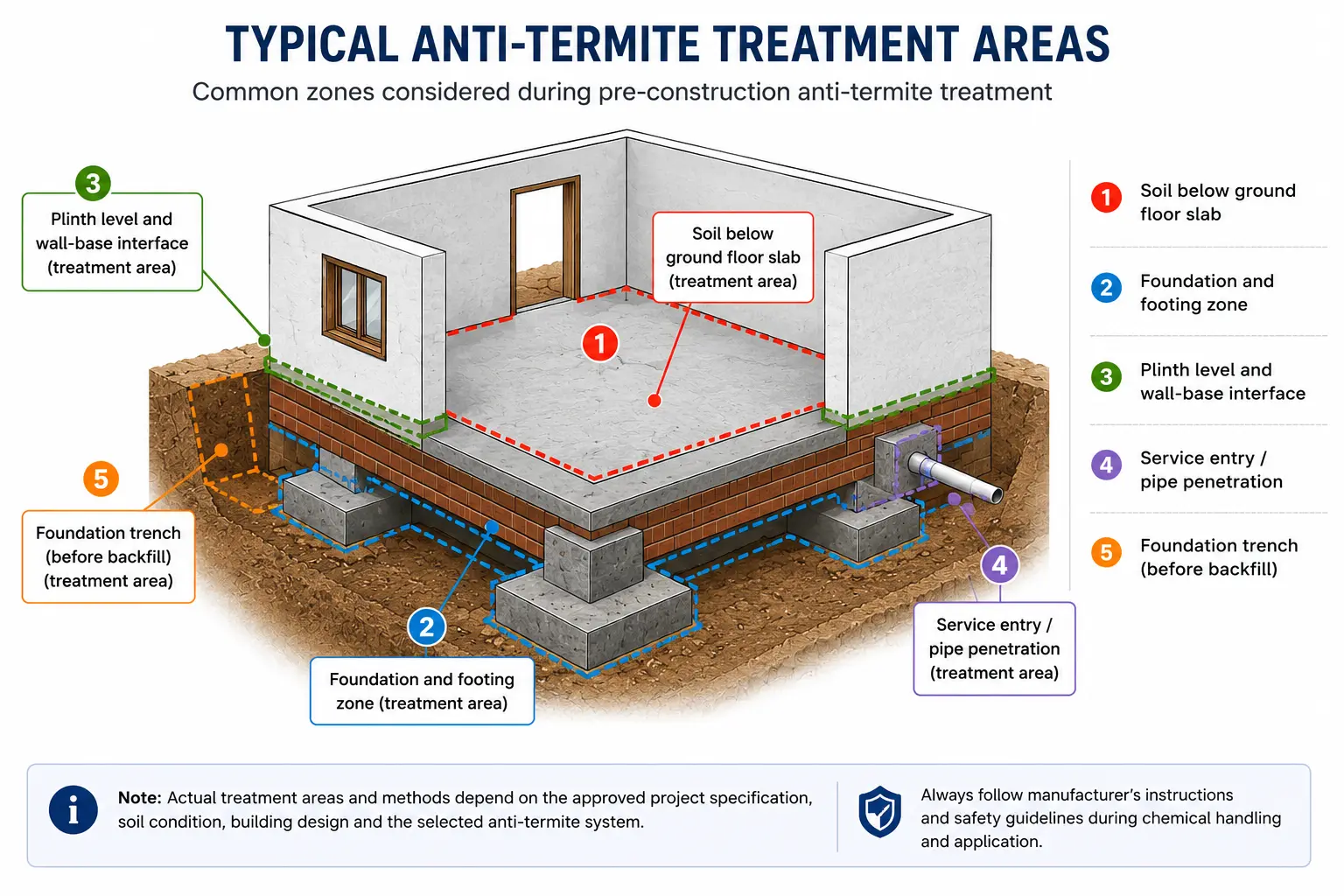
Figure: Typical anti-termite treatment areas for preliminary estimation and educational reference.
About the Anti-Termite Treatment Calculator
The Anti-Termite Treatment Calculator is a preliminary quantity-estimation tool for estimating the amount of prepared treatment solution required for selected building areas. It is mainly useful when preparing early-stage material estimates for soil and building interfaces included in an approved termite-treatment system.
The calculator uses a simple relationship between the treatment area and the application rate. It does not determine which chemical should be used, whether a particular treatment method is suitable, or whether a building is adequately protected against termites.
Actual treatment work must be based on the approved project specification, construction details, selected treatment system, manufacturer's current instructions, site conditions, applicable standards, and local regulatory requirements.
What Is Anti-Termite Treatment?
Termites can enter a building through soil and other concealed interfaces between the ground and the structure. Anti-termite treatment is intended to reduce the likelihood of termite entry and infestation by creating a treated zone or barrier at locations identified by the approved treatment system.
The treatment arrangement is not necessarily identical for every building. Foundation construction, floor construction, plinth details, service penetrations, soil conditions, building use, construction sequence, and the selected chemical or non-chemical system can all affect the treatment requirement.
For quantity estimation, it is therefore important to first identify which areas are actually specified for treatment and then apply the appropriate rate to each zone.
Pre-Construction vs Post-Construction Treatment
One of the most important distinctions in termite control is whether treatment is being planned for a new building under construction or for an existing building where termite activity has already been identified.
Pre-construction treatment:
Pre-construction treatment is carried out during the construction sequence, before selected soil-to-building interfaces become inaccessible. Depending on the approved system, treatment may involve soil below floor areas, foundation-related zones, plinth areas, trenches, and other vulnerable interfaces.
Post-construction treatment:
Post-construction treatment applies to an existing building or an already completed portion of a structure. It may require inspection to identify termite activity, entry routes, damaged areas, concealed paths, service penetrations, or locations where a treatment barrier has been interrupted.
Post-construction work can involve different procedures from pre-construction treatment. Therefore, a calculator intended for preliminary pre-construction quantity estimation should not automatically be interpreted as a complete post-construction termite-control design.
Common Treatment Zones in a Building
The exact treatment zones must come from the approved specification and construction details. Common areas that may be considered include:
1. Soil below floor areas: Soil beneath ground-floor construction may be included where the specified treatment system requires protection of the floor-to-soil interface.
2. Foundation and trench areas: Foundation trenches and soil around or adjacent to foundations may form part of the treatment arrangement depending on the construction detail.
3. Plinth and floor interfaces: Junctions between the building structure, plinth and surrounding soil may require particular attention because they can provide concealed routes for termite entry.
4. Service penetrations: Pipes, ducts, sleeves and other service openings can interrupt building interfaces and should be considered where the approved treatment system requires it.
5. External soil adjacent to the structure: Certain systems may include treatment of soil immediately adjacent to foundations or other building interfaces. The required extent must be established from the approved method rather than assumed.
These zones should be measured separately when their application requirements differ. The calculator should only be used for areas that are actually included in the treatment scope.
How the Calculator Estimates Treatment Solution
The basic quantity calculation is based on the treatment area and the specified application rate.
Required Prepared Solution = Treatment Area × Application Rate
Treatment Area = area requiring treatment, generally expressed in m².
Application Rate = quantity of prepared treatment solution required per unit area.
Required Prepared Solution = estimated quantity of diluted or prepared solution required for the entered area.
For example, if a treatment zone is 100 m² and the approved application rate is 5 L/m²:
Required Solution = 100 × 5 = 500 L
The 500 L represents the calculated quantity of prepared treatment solution at the stated application rate. It should not automatically be interpreted as 500 L of chemical concentrate.
Application Rate Is an Assumption, Not a Universal Value
The application rate is one of the most important inputs in the calculator. It should not be treated as a universal rate applicable to every chemical, soil condition, construction detail, or treatment method.
The appropriate rate can depend on the approved product, formulation, concentration, treatment location, application method, project specification and manufacturer's instructions.
Therefore, a value entered into the calculator should represent the approved application rate for the specific treatment system. The calculator performs the mathematical estimation; it does not validate whether the entered rate is technically or legally appropriate.
If two treatment zones have different specified rates, calculate them separately:
Total Solution = (Area₁ × Rate₁) + (Area₂ × Rate₂) + (Area₃ × Rate₃)
This method is preferable to applying one assumed rate to the entire building.
Worked Example for Quantity Estimation
Consider a building where the approved treatment specification identifies three areas:
Floor zone: 80 m² at 5 L/m²
Foundation-related zone: 30 m² at 4 L/m²
Other specified zone: 20 m² at 3 L/m²
The estimated prepared solution is:
Floor zone = 80 × 5 = 400 L
Foundation zone = 30 × 4 = 120 L
Other zone = 20 × 3 = 60 L
Total prepared solution = 400 + 120 + 60 = 580 L
This example demonstrates why treatment zones should be separated when their application rates are different. The values are illustrative and must not be interpreted as universal treatment rates.
Chemical Concentration and Dilution
Treatment quantity and chemical concentrate quantity are two different concepts. The calculator may estimate the quantity of prepared solution, but the amount of commercial concentrate required depends on the approved product and its specified dilution procedure.
For example, a product may require a particular quantity of concentrate to be mixed with water to prepare the required solution. That relationship must be taken directly from the current product label or technical documentation.
Do not infer chemical concentration from the calculator's area calculation. Area × application rate determines solution quantity only. It does not establish the correct active ingredient concentration.
Never change the manufacturer's recommended dilution ratio simply to reduce chemical consumption. Chemical handling, mixing and application should be performed by appropriately trained personnel using the required personal protective equipment and safety procedures.
Measuring the Treatment Area
Accurate area measurement is essential because the estimated solution quantity changes directly with the treatment area.
For a rectangular area:
Area = Length × Width
For an irregular building footprint, divide the plan into measurable sections such as rectangles and other simple shapes. Calculate each section separately and combine only the areas actually included in the treatment specification.
Check the latest architectural and structural drawings before taking quantities. Do not automatically use the gross floor area of the building if only a portion of the floor or soil area requires treatment.
Openings, excluded areas, untreated zones and overlapping measurements should be checked carefully so that the same area is not counted twice.
Soil and Site Conditions
Mathematical quantity estimation does not replace site assessment. Soil and site conditions can influence the practical application process and may affect whether a proposed treatment method is suitable.
Soil texture and condition: Different soils can behave differently during application, particularly with respect to absorption, moisture and surface condition.
Moisture condition: Existing moisture and site drainage conditions can affect practical treatment operations.
Compaction and construction sequence: Soil preparation and subsequent construction activities can affect the continuity of a treated zone.
Access: Restricted areas, concealed interfaces and construction-stage accessibility can affect how the specified treatment is implemented.
Drainage and water movement: Surface drainage and other site conditions should be considered as part of the overall termite-control strategy.
These factors cannot be evaluated by an area-and-rate calculator alone.
Maintaining Continuity of the Treatment Zone
Effective termite protection is not simply a matter of calculating litres of solution. Where a treated zone or barrier is specified, continuity at building interfaces is an important consideration.
Construction activities can create interruptions at foundations, service entries, joints, floor interfaces and other locations. These details should therefore be reviewed against the approved treatment specification and construction sequence.
A mathematically correct quantity estimate does not by itself prove that the completed building has a continuous or effective termite barrier.
Pre-Construction Treatment Workflow
A practical preliminary estimating workflow can be organized as follows:
Step 1: Review the latest architectural, structural and construction drawings.
Step 2: Identify the soil-to-building interfaces and other zones included in the approved treatment specification.
Step 3: Measure each treatment zone in compatible units, normally m² for area-based estimation.
Step 4: Confirm the approved application rate for each zone from the project specification and product documentation.
Step 5: Calculate the prepared solution quantity using area × application rate.
Step 6: Compare the calculated quantity with the BOQ, procurement estimate and site requirements.
Step 7: Verify actual application and safety procedures with the responsible treatment professional or contractor.
Post-Construction Termite Treatment
Existing buildings require a different approach because the original construction interfaces may already be concealed or inaccessible.
A post-construction assessment may need to consider visible termite activity, damaged timber or other materials, concealed entry routes, cracks or openings, service penetrations, moisture sources, soil contact and areas where an existing treatment barrier may have been disturbed.
The quantity of treatment solution for an existing building should therefore not be estimated simply by multiplying the total floor area by a generic rate. The actual treatment procedure depends on the inspection findings and the approved remediation method.
This calculator should consequently be treated as a preliminary estimation tool and not as a complete post-construction termite-control procedure.
Factors That Can Change Actual Consumption
The calculated quantity is theoretical. Actual field consumption can differ because of:
• Treatment area: Incorrect measurements directly affect the estimated quantity.
• Application rate: Different approved systems may specify different rates.
• Soil condition: Surface and soil characteristics can affect application.
• Construction sequence: Timing and accessibility can affect practical application.
• Treatment zones: Different locations may have different specified procedures.
• Site wastage: Practical losses may occur during preparation and application, but any estimating allowance should follow the project's accepted practice.
• Product instructions: The approved product determines preparation, concentration and application requirements.
Common Estimating Mistakes
Using total building area: The complete floor area may not be the same as the actual treatment area.
Using an arbitrary application rate: A convenient value should not replace the rate specified for the approved treatment system.
Confusing concentrate with prepared solution: The volume of prepared solution is not automatically equal to the volume of chemical concentrate.
Ignoring different zones: Applying one rate to floor, foundation and other areas can produce an incorrect estimate when the specification uses different rates.
Ignoring construction details: Service penetrations, plinth interfaces and other vulnerable locations can be missed when estimating only from gross floor area.
Changing chemical dilution to save material: The manufacturer's specified concentration and preparation procedure should never be altered for estimating convenience.
Units Used in the Calculation
Treatment area is generally entered in square metres (m²), while application rate may be expressed as litres per square metre (L/m²). The resulting prepared solution quantity is then expressed in litres (L).
Always check that the units of area and application rate are compatible. For example, an area measured in square feet must be converted before using an application rate expressed in litres per square metre.
What This Calculator Does Not Determine
This calculator does not determine:
• Which termite-control chemical should be selected
• The legally permitted chemical or active ingredient
• The correct concentration or dilution ratio for a product
• Whether a particular treatment system is suitable for a site
• Whether an existing building requires post-construction treatment
• Whether the completed treatment provides complete termite protection
• Site-specific chemical handling or safety procedures
• Regulatory approval or certification of the treatment work
Practical Quantity-Estimation Tips
For a reliable preliminary estimate, prepare a simple treatment-area schedule showing the zone description, measured area, applicable rate and calculated solution quantity.
For example:
Zone A: 100 m² × 5 L/m² = 500 L
Zone B: 40 m² × 4 L/m² = 160 L
Zone C: 20 m² × 3 L/m² = 60 L
Total = 720 L of prepared solution
Keeping the calculation in this format makes it easier to compare the estimate with drawings, BOQ quantities and procurement requirements.
Limitations and Engineering Considerations
The Anti-Termite Treatment Calculator performs a mathematical quantity estimate from user-provided inputs. It does not inspect the building, soil, construction sequence or existing termite conditions.
Actual termite-control requirements can depend on building design, soil conditions, construction details, treatment technology, chemical product, environmental conditions and local requirements. These factors cannot be completely represented by a simple area × rate calculation.
A calculated quantity should therefore not be interpreted as proof that the proposed treatment will be effective or that the building complies with a particular regulatory requirement.
For new construction, treatment details should be coordinated with the construction drawings and approved specification. For existing buildings, a qualified termite-control professional should assess the site and determine the appropriate treatment procedure.
Chemical products must be handled strictly according to their current label, technical documentation and safety requirements. Applicable environmental, occupational-safety and local regulatory requirements should also be followed.
FAQs
Q: What does the Anti-Termite Calculator calculate?
A: It estimates the quantity of prepared treatment solution using the treatment area and application rate entered by the user.
Q: Is the application rate universal?
A: No. The appropriate rate depends on the approved treatment system, product instructions, treatment location and project requirements.
Q: Does the calculated solution quantity equal chemical concentrate quantity?
A: No. Prepared solution and chemical concentrate are different quantities. Concentrate requirements depend on the product's approved dilution instructions.
Q: Can I use the calculator for pre-construction treatment?
A: Yes, it can be used for preliminary quantity estimation when the treatment area and approved application rate are known.
Q: Can I use it for post-construction termite treatment?
A: It may assist with simple quantity calculations, but post-construction treatment requires site inspection and a treatment procedure appropriate to the existing building. The calculator should not be treated as a complete post-construction treatment design.
Q: Should the entire floor area be treated?
A: Not automatically. Only the areas included in the approved treatment specification should be included in the estimate.
Q: Should different treatment zones be calculated separately?
A: Yes, particularly when different zones have different application rates or treatment requirements.
Q: Can I change the chemical dilution ratio to reduce the quantity of concentrate?
A: No. Chemical dilution and preparation must follow the approved product instructions. The calculator should not be used to modify chemical concentration.
Q: Does the calculator guarantee termite protection?
A: No. It only performs a preliminary quantity calculation. Effective termite control depends on the selected treatment system, correct application, construction detailing, site conditions, maintenance and other factors.
Important Note
The Anti-Termite Treatment Calculator is intended for preliminary quantity estimation and educational purposes. It does not replace a site inspection, approved termite-treatment specification, professional pest-control assessment, product label or technical documentation.
Before actual treatment, verify the treatment zones, application rate, chemical product, concentration, dilution procedure, application method, safety requirements and applicable local regulations with the responsible project professional or authorized treatment provider.